Lightweight Airless Tires for a Child's Balance Bike: Design Guide
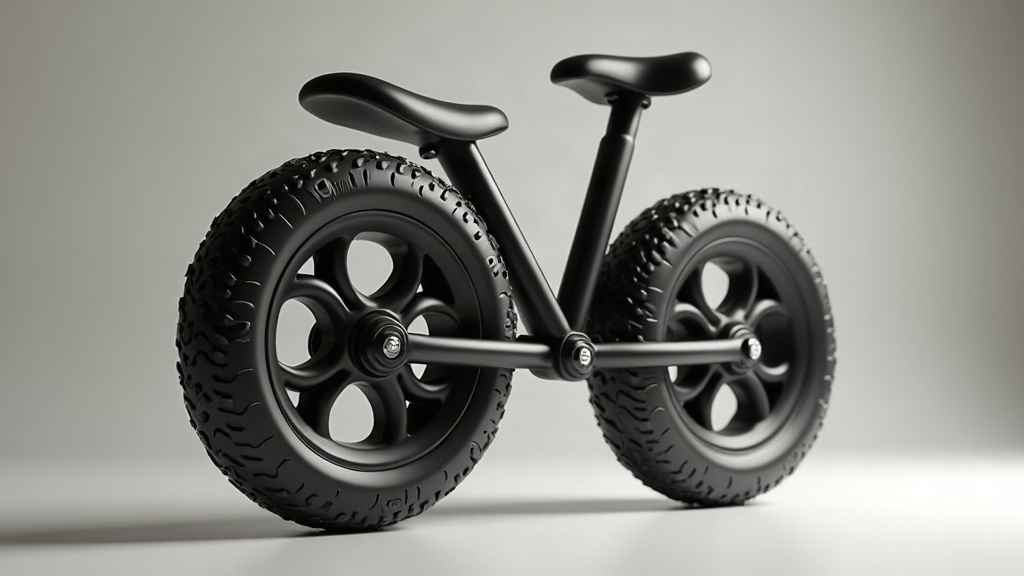
Designing a lightweight airless tire for a kid’s balance bike is really a juggling act between three things that don’t naturally want to cooperate: keeping rolling weight as close to zero as possible, giving a toddler enough cushioning to stay comfortable over sidewalk cracks and gravel, and making the whole thing flat-proof so parents never have to touch a pump. Nail the material density, the tread geometry, and how the tire mates to the hub, and you get a wheel that needs zero maintenance for years. That’s the whole appeal of airless tires on balance bikes in the first place.
Why Airless Tires Make Sense on Balance Bikes
Balance bikes are for kids roughly 18 months to 5 years old, and the combined weight of child plus bike usually stays under 40 lbs (18 kg). That’s a tiny load. Because of it, designers don’t need the pressurized air chamber that bigger, heavier bikes rely on. A solid or foam-filled tire handles the job just fine, with way less engineering risk attached.
Why airless wins here:
- No pressure loss. A toddler isn’t going to check PSI before a ride, and airless tires don’t ask them to.
- Puncture immunity. Thorns, gravel, curb strikes, none of it stops the ride.
- Lower long-term cost. No tubes to replace, no patch kits in the garage, no emergency trips to the bike shop.
- Predictable weight budget. Pneumatic tires carry a rim, a tube, and a valve as three separate parts. Airless tires fold all of that into one molded piece.
Material Choices: What “Lightweight” Actually Means
The biggest lever a designer has is the polymer itself. Three approaches show up again and again:
1. EVA (Ethylene-Vinyl Acetate) Foam
EVA is the lightest option you can realistically use, often 30-40% lighter than solid rubber at the same volume. It’s closed-cell, so water doesn’t soak in, and its density can be dialed in (typically 0.08-0.15 g/cm³ for tire cores) just by adjusting the foaming agents during molding. The catch: it wears faster under abrasion, so most EVA tires need a thin rubber or TPU layer bonded onto the tread to survive pavement.
2. Polyurethane (PU) Foam
PU strikes a better balance between durability and weight than EVA on its own. Microcellular PU tires compress under load and rebound, soaking up small bumps the way a low-pressure pneumatic tire would, minus the bladder and the risk of a flat. This is the material you’ll find in most premium “cushioned” airless balance bike lines, and it’s not an accident. It just performs better over three years of daily sidewalk abuse.
3. Solid Rubber (Budget Tier)
Solid rubber is the heaviest choice and it transmits a lot more vibration straight up through the frame. It’s also cheap and nearly indestructible. If lightweight is the design brief, solid rubber usually gets dropped from the list, unless the budget is so tight that cost trumps everything else.
Tread Pattern and Wall Design for Low Weight
Weight isn’t just a material question. Geometry pulls just as much weight (pun intended):
- Radial venting channels or honeycomb cores strip mass out of the tire’s interior while leaving the outer wear surface untouched. A honeycomb-core airless tire can cut 15-25% of total weight compared to a fully solid tire of the same diameter.
- Shallow, widely spaced lugs lower rolling resistance, and for a 2-year-old whose leg strength is, let’s be honest, pretty minimal, that matters a lot more than aggressive grip.
- Tapered sidewalls (thinner near the hub, a bit thicker at the tread) trim mass from the areas carrying the least structural load.
Hub and Rim Interface
Most airless balance bike tires get molded directly onto a plastic or aluminum hub, which skips the rim-bead interface pneumatic tires depend on entirely. That saves weight in two places at once: there’s no separate rim channel to build, and the molding process makes valve stems and rim tape unnecessary. Designers should still spec a mechanical lock, keyed hub teeth rather than adhesive alone, so the tire can’t spin loose under the braking torque from a coaster or drum brake. Glue by itself just isn’t reliable enough for that job.
Weight Targets and Real-World Numbers
A 12-inch balance bike’s front and rear tires combined should land somewhere between 180-260 grams for a lightweight foam build, versus 350-450 grams for the solid rubber equivalent. That gap matters more than it sounds like it should. Every 50 grams shaved off the wheel affects a toddler’s pedaling effort more than the same 50 grams removed from the frame, simply because wheel mass is rotational, it’s weight the kid has to spin up with every pedal stroke, not just carry.
Safety and Durability Checks Before Production
- Compression set testing: the foam has to bounce back to its original shape after sitting under load overnight (a bike left parked in the garage), without developing a flat spot.
- UV and temperature stability: EVA and PU both degrade under direct sun across multiple summers, so additives for outdoor durability aren’t optional if the bike is going to live outside.
- Bond strength: the tire-to-hub joint has to survive repeated curb impacts without the tread peeling away from the hub.
Conclusion
In the end, a lightweight airless balance bike tire comes down to three decisions: pick the right foam density, strip out unnecessary mass through venting and tapering, and lock the tire to the hub mechanically rather than trusting adhesive alone. Get those three right and you end up with a tire that’s lighter than a pneumatic setup, never goes flat, and holds up for the full 2-3 years a kid typically rides the bike. For a product category this small, it’s one of the highest-value engineering decisions anyone makes.